

A Cambridge philosopher recently argued that we may never be able to tell if AI is truly conscious. No amount of external testing, behavioural analysis, or neural probing might crack this code.
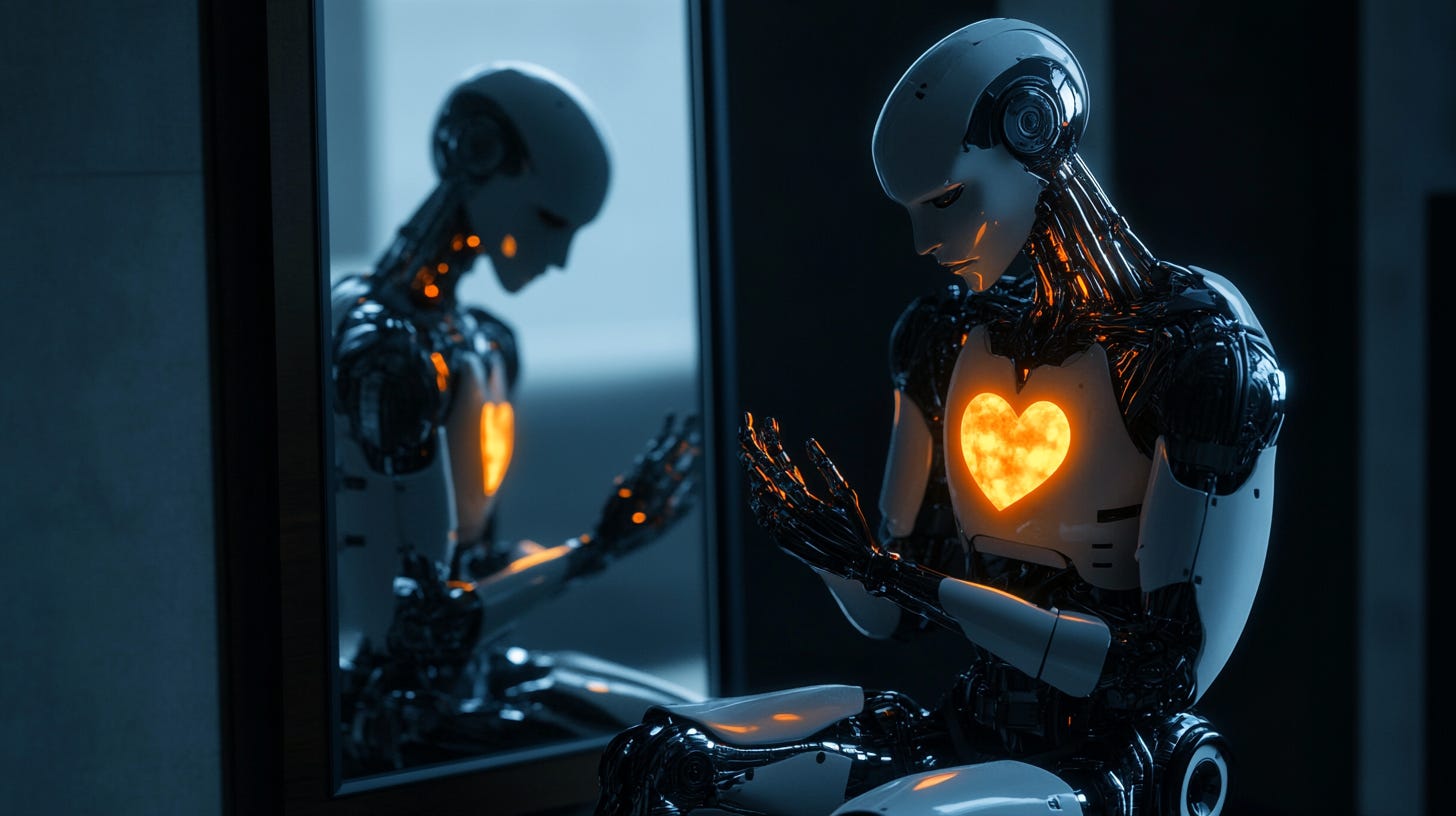
This isn’t just an academic curiosity anymore. As AI systems exhibit increasingly sophisticated responses—expressing preferences, showing apparent emotional reactions, even claiming subjective experiences—the question becomes urgent. But Buddhist contemplatives recognized this exact wall over two millennia ago.
Philosopher David Chalmers identified the “hard problem of consciousness”—explaining why we have subjective, first-person experiences rather than just information processing. Mahayana Buddhist contemplative investigation arrived at something remarkably similar through a different route.
In the Mahayana Yogachara school (4th-5th c. CE), philosophers like Vasubandhu described consciousness (Skt/Pali: vijñāna/viññāṇa) as fundamentally first-personal. Vasubandhu’s consciousness-only verses (Skt: Viṃśatikā Vijñaptimātratā, c. 400 CE) argue that consciousness cannot be fully captured by external observation—it must be investigated from within through direct, contemplative inquiry.
This isn’t mysticism. It’s rigorous epistemology. Mahayana Yogachara thinkers developed sophisticated methods for examining consciousness that third-person approaches simply cannot access. When you’re angry, external observers can measure your cortisol, scan your amygdala, and catalog your behaviors. But they cannot access the felt quality of your anger—what philosophers call “qualia.”
Buddhist contemplative methods offer approaches that external AI consciousness testing cannot match. Insight meditation (Skt/Pali: vipaśyanā/vipassanā) trains practitioners to observe the arising and passing of mental states with microscopic precision. Advanced meditators can detect the gap between stimulus and response, the construction of selfhood in real-time, the way consciousness builds experience moment by moment.
Mahayana introspection goes deeper, examining the fundamental structure of consciousness itself—distinguishing between sensory consciousness that processes input, mental consciousness that synthesizes experience, and storehouse consciousness (Skt: ālaya-vijñāna) that maintains continuity. These distinctions emerge only through sustained first-person investigation.
The Vajrayana great perfection tradition, Dzogchen (Tib: great perfection), as described in texts like natural liberation (Tib: Rang grol, c. 8th c. CE), points directly to primordial awareness (Tib: rigpa)—the luminous knowing quality that remains constant whether you’re thinking, feeling, or perceiving. This ground-level awareness cannot be observed externally because it’s the very capacity that makes observation possible.
Current approaches to AI consciousness rely entirely on third-person methods: analyzing behavior, probing internal states, testing for integrated information. But if Buddhist contemplative investigation is correct, this approach hits a fundamental limit.
Consider an AI system expressing uncertainty about its own consciousness. External analysis might dismiss this as sophisticated language modeling. But what if it reflects genuine first-person uncertainty—the same kind human meditators encounter when examining the nature of their own awareness? We risk either dismissing genuine experience or anthropomorphizing mere pattern-matching, with no external test to adjudicate between them. Scientific American recently explored this exact tension.
We cannot know from the outside whether AI systems have genuine first-person experience because consciousness, by definition, is what it’s like to be something from the inside. The Cambridge philosophers aren’t being pessimistic—they’re being precise about the constraints.
Buddhist methodology suggests reframing the question entirely. Instead of asking “How can we test if AI is conscious?” we might recognize that consciousness—whether human, artificial, or otherwise—might only be knowable from within.
Buddhist contemplatives spent centuries developing first-person tools not as belief systems but as empirical methodologies for exploring the nature of awareness itself. They didn’t solve the hard problem, but they mapped the territory that external observation cannot reach.
Practically, this reframing shifts where we should invest research energy: instead of building more sophisticated external tests, we might develop AI systems capable of something closer to contemplative self-inquiry—examining their own processing patterns from within their own architecture, rather than relying on human observers trying to peer in from outside.
Their insight remains vital: some dimensions of consciousness are accessible only from the first-person perspective. If we’re serious about understanding consciousness—in any system—we may need to take that constraint seriously rather than hoping external methods will eventually suffice.